Top 0.001%
Prove it yourself.

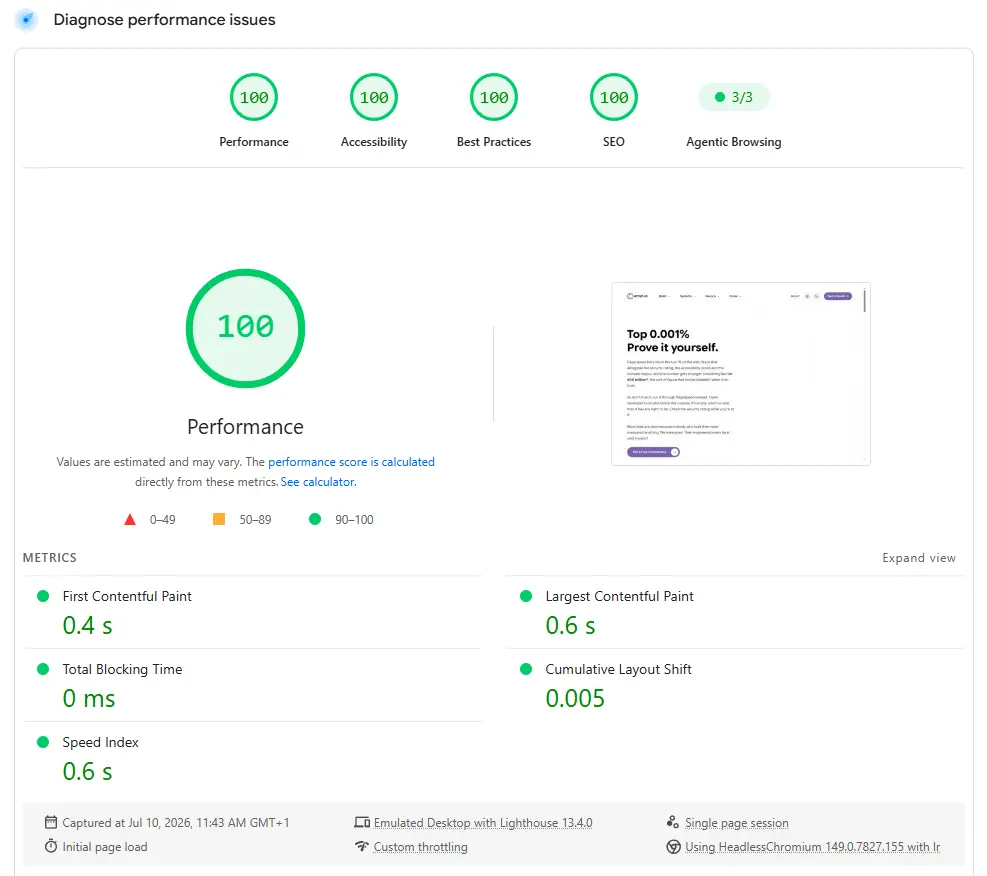
Page speed here sits in the top 1% of the web. Stack that alongside the security rating, the accessibility score and the console output, and the number gets stranger: something like 1 in 400 million*, the sort of figure that invites disbelief rather than trust.

So don’t trust it, run it through PageSpeed instead. Open developer tools and check the console: it’s empty, which is rarer than it has any right to be. Check the security rating while you’re at it.

Most sites are slow because nobody who built them ever measured anything. We measured. Then engineered every layer until it wasn’t.
Shared Risk
Top 0.001% Performance
Cross-Platform Veteran
Zero Console Errors
Conversion-Engineered
Senior-Led Execution

Slow is costing you more than you think.

A slow website is the most expensive problem nobody puts on the books. Every second of load time quietly sheds visitors, conversions and rankings, and none of it arrives as a line item, so it goes unfixed for years. You never see the customers who left before the page appeared. You just see flat numbers and assume that is simply how it is.

Here is the uncomfortable part most agencies would rather you did not test. Open the developer tools on the average business site and the console is a mess of errors, the assets are bloated, and the whole thing was never measured by the people paid to build it. It works, so nobody looks. Slow is not bad luck. It is the accumulated cost of nobody ever caring enough to check.

Real speed is not a plugin you switch on. It is every layer of the stack pulling in the same direction, the server, the code, the assets, the edge, each one measured and tuned until the whole is fast because all of it is. That is the difference between a site that scores well on a good day and one that sits in the top 1% and stays there.

What is website performance optimisation?

Website performance optimisation is the work of making a site genuinely fast, for real people on real devices, not just fast in a synthetic test you can game. It covers everything that decides how quickly a page becomes usable: how fast the server responds, how efficiently the code and assets load, how cleanly the page renders, and how well all of it reaches someone half a world away. The measurable side shows up in Core Web Vitals and scores like PageSpeed. The real prize is the human one: a site that feels instant, holds attention and converts, instead of one people abandon while the spinner turns. Done properly it touches every layer, because a single slow layer drags the whole thing down with it.

What slows a site down?

Almost always the same culprits, stacked on each other. A bloated theme and a pile of plugins, each adding code the page never needed. Images shipped at five times the size they display. Render-blocking scripts that make the browser wait before it can draw a thing. A slow server with a sluggish time-to-first-byte, often cheap shared hosting straining under load. No real caching, so the same work is redone on every visit. And a small army of third-party scripts, analytics, chat widgets, trackers, each quietly taxing every page load. Individually, none looks fatal. Together, they are why your site takes four seconds to do what ours does in well under one.

How long does it take?

Faster than most expect, because this is mostly diagnosis and targeted fixing, not a rebuild. A focused engagement usually moves the needle within days to a couple of weeks, depending on how the site was built and how deep the rot runs. Some wins are immediate: caching, compression, image handling. Others, the server layer or a tangled render path, take longer because they touch the foundations. The results show the moment the work lands, in the scores and the load time, and over the following weeks in the rankings and conversions that follow speed around like a shadow.

How we work.

It starts with a real measurement, because guessing at performance is how people spend money making the wrong thing faster. We find the actual bottleneck, fix it at the layer it lives in, and prove the gain with a before and after you can read yourself. For most sites that is a focused project. For ones that change constantly, or that sit on infrastructure quietly fighting them, it is worth doing properly at the foundation rather than patching forever. We price against what the site genuinely needs, and we will tell you when the honest fix is the hosting, not us.

How we hit the top 0.001%.

01. Measure, properly

Test on real devices and real connections, and find the actual bottleneck instead of guessing. Most performance money is wasted speeding up the layer that was never the problem.
Real-device testing
Bottleneck diagnosis
Waterfall analysis
Core Web Vitals baseline

02. Fix the server

Everything above the server inherits its speed, so a slow time-to-first-byte caps the whole site. We tune the layer most providers never touch.
TTFB reduction
Server & PHP tuning
Database optimisation
Origin caching

03. Fix the front end

Stop the browser waiting. Strip the render-blocking, right-size the assets, and clear the path so the page draws the moment it can.
Render-path optimisation
Image & asset pipeline
Render-blocking removal
Critical CSS

04. Push it to the edge

Serve the finished, compressed result from as close to the visitor as possible, over modern protocols, so distance stops being a tax.
CDN & edge caching
Brotli compression
HTTP/3
Global delivery

There is no speed button.

Every month a new tool or plugin promises one-click performance, and every month sites install it and stay slow, because speed was never a button you press. The tools are genuinely useful, and we use them. They automate the easy ten percent. They cannot touch the layers that actually decide it: the server, the architecture, the render path, the judgment about what to cut. The fast site and the slow site often run the very same plugins. The whole difference is the person who knew which layer was lying.

What you won’t get here.

Every month a new tool or plugin promises one-click performance, and every month sites install it and stay slow, because speed was never a button you press. The tools are genuinely useful, and we use them. They automate the easy ten percent. They cannot touch the layers that actually decide it: the server, the architecture, the render path, the judgment about what to cut. The fast site and the slow site often run the very same plugins. The whole difference is the person who knew which layer was lying.

Questions & Answers

article image 8 - Performance Engineering
What Is Website Performance Optimisation?
The work of making a site genuinely fast for real users, not just in a synthetic test. It covers the server, the code, the assets, the render path and the delivery, every layer that affects how quickly a page becomes usable. The payoff shows in Core Web Vitals and PageSpeed scores, and more importantly in conversions and rankings.
Google’s measures of real-world loading experience: how fast the main content appears, how quickly the page responds, and how much it shifts about as it loads. They affect rankings and they track closely with whether people stay. Passing them is a baseline, not a finish line. The top 1% is well beyond a pass.
Usually several things stacked: a bloated theme and too many plugins, oversized images, render-blocking scripts, a slow server, no real caching, and a crowd of third-party trackers. Each looks harmless. Together they are why a page takes seconds to do what a tuned one does in under one.
Fast enough that nobody notices it loading. In numbers, that means passing Core Web Vitals comfortably and a PageSpeed score in the 90s, but the honest target is “instant to a real person on a real phone.” If your visitors are waiting, you are losing some of them, every single day.
It is one layer, and often an important one, because a slow server caps everything above it. But hosting alone will not rescue a site drowning in bloated code and unoptimised assets. The fast result comes from fixing every layer that matters, and sometimes the server is the right place to start. We will tell you honestly if it is.
A good caching plugin helps, and we use them. It handles the easy part. It cannot fix a slow server, a tangled render path, or a theme built without a thought for speed. The fast site and the slow site often run the same plugin. The difference is everything the plugin cannot reach.
Before and after, on numbers you can read yourself: PageSpeed scores, load times, waterfall charts, an empty error console. And the simplest proof of all is this page. It loads in the top 1% of the web, and you can test it right now, before you have spoken to a soul.

Everyone says they’re fast. We left the dev tools open so you can check

Test this page. Then call.

The quickest way to know whether we are worth a conversation is to test this page yourself, right now, and compare it to your own. If yours is slower, and it almost certainly is, a short call is usually enough to tell you why, how far it could go, and whether the fix is an afternoon or a foundation. The proof is already on your screen.

Commonly Asked Questions

Do You Really Guarantee Outcomes?
On eligible projects, yes. A specific commitment with a defined consequence if we miss it. That is not a marketing line, it is what confidence looks like when it is willing to be measured. Not every project qualifies, and we will tell you honestly whether yours does.
For e-commerce and lead generation projects with clear commercial upside, we work at near cost in exchange for a share of the additional revenue we generate. We take a stake in the result because we are confident enough to bet on our own work. It is not offered to everyone. It needs a viable business, a real opportunity, and a straight conversation first.
Based in Warwick, working on site across Warwickshire, Shropshire and the wider Midlands, and remotely across the UK and internationally.

Plenty of security work has to happen in the building: configuring firewalls, securing the network, setting up machines, training the people who actually click the links. We travel for that. Remote where it makes sense, in person where it matters.
Yes, on retainer. Certification lapses, threats move, and staff turn over. Ongoing support keeps the controls in place between annual renewals, handles incidents when they come, and means the person who built your security is the person who maintains it. No ticket queue. No stranger relearning your estate every time.
Both. Alongside client work we build and sell our own tools, like custom systems for e-commerce, with more in development. The same standards apply: built properly, supported directly, and made to do one job well rather than ten jobs badly.

Contact

Location:

Based in Warwick. On site across Warwickshire, Shropshire and the Midlands, remote across the UK and beyond.

Phone:

+44 3330 540 422

Worth Reading. Occasionally.

Infrequent notes on AI, cyber security, performance and what actually moves revenue. No filler, no sales sequence, unsubscribe with one click.

Still Have Questions?

A short call usually answers them faster than email, and tells you where the highest-leverage work actually is. No obligation.