Stop doing what software should.
Somewhere in your business, a person is moving the same number between two screens. Every day, by hand.
That is the work a CRM automation consultant exists to end: find the manual handoffs, connect the systems that should have been talking all along, and let the software carry what it was built to carry.
That is the work a CRM automation consultant exists to end: find the manual handoffs, connect the systems that should have been talking all along, and let the software carry what it was built to carry.









Your tools don't integrate. So your staff do.
It happens by accretion, never by design. The CRM arrived first, then the accounting package, then the helpdesk, then a spreadsheet somebody built on a wet Friday and never spoke of again. Nobody introduced any of them, so they sit in the same business like guests at a party who refuse to make eye contact.
Which means a person became the integration layer. They export a file from one system, reformat it, paste it into the next. They retype the order into the accounts package. They copy the email address from the inbox into the CRM, again, because the two have never once exchanged a word. It looks like work. It is mostly translation, and you are paying salary rates for the privilege of a human USB cable.
That is the gap a CRM automation consultant closes, and not by selling you yet another tool to ignore. By making the systems you already own behave like one, and by quietly retiring the person currently being paid to hold them together with both hands.
Which means a person became the integration layer. They export a file from one system, reformat it, paste it into the next. They retype the order into the accounts package. They copy the email address from the inbox into the CRM, again, because the two have never once exchanged a word. It looks like work. It is mostly translation, and you are paying salary rates for the privilege of a human USB cable.
That is the gap a CRM automation consultant closes, and not by selling you yet another tool to ignore. By making the systems you already own behave like one, and by quietly retiring the person currently being paid to hold them together with both hands.
What is CRM automation?
CRM automation is the practice of connecting your customer system to the rest of your software, then letting defined triggers do the repetitive work a person is currently doing by hand and resenting. An enquiry lands and the record writes itself. The right follow-up fires, the deal moves stage, the quote drafts, the invoice raises, and the accounts package hears about it without anyone retyping a single field. It runs on the same logic your best operator keeps in their head, set down once and then executed every time, with no fatigue, no Mondays and no holiday entitlement. A CRM automation consultant designs those flows around how your business genuinely works, rather than how a vendor's demo assumed it would. The point is never more automation for its own sake. It is the right automation, on the processes that earn their keep, and a firm nothing on the ones that do not.
When should you automate?
Less often than the software adverts insist, and more decisively than the dread tends to allow. The honest triggers are few and unmistakable. A person is burning real hours on what a trigger could finish in milliseconds. The same number is typed into two systems because neither will lower itself to speak to the other. Errors are breeding at the handover points, where everyone's attention goes to die. Growth has turned a tolerable manual chore into a second full-time job nobody budgeted for. Or you cannot answer a basic question about your own pipeline without three exports and a quiet prayer. Tick one and automation repays itself fast. Tick none, and you are automating for the sheer joy of having automated, which is a hobby, not a strategy.
How long does it take?
It depends entirely on the tangle, and anyone quoting a flat number before seeing your systems is reading tea leaves. A single, well-behaved integration can be live in days. A whole estate, knotted with a decade of load-bearing spreadsheets and integrations nobody can explain, takes longer, and most of that time is spent understanding the thing before laying a finger on it. The building is the quick bit. The thinking that stops the whole arrangement collapsing on a random Tuesday is where the hours actually go.
How we work.
It opens with the least profitable question we ever ask: should you do this at all. If the answer is yes, we watch where the manual work really happens, design the flows around how the business actually operates, build them somewhere they cannot break anything live, then switch them on one at a time so any mistake stays small and embarrassing rather than large and expensive. You watch the hours come back. We price against the mess we actually find, not a tidy fiction that overcharges the simple jobs and quietly haemorrhages money on the hard ones. The person who maps it is the person who builds it. No handoffs, no relay race.
We connect the stack.
01. CRM, built around how you sell
The customer system set up around how you actually sell, not how the demo pretended you would. Pipeline, lifecycle and data clean enough to trust before the first coffee.
Lead lifecycle & pipeline design
Deduplication & data hygiene
tage automation & stalled-deal alerts
HubSpot, Salesforce, Pipedrive etc & custom systems
Lossless migration from the old system
02. Systems that finally talk
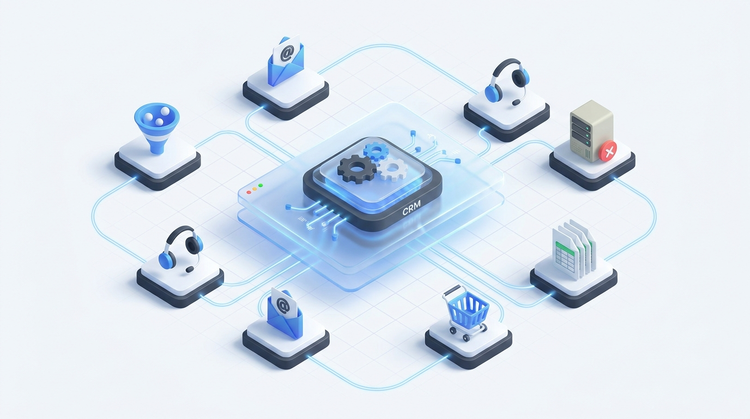
One source of truth, the rest kept in step without a human courier. An end to exporting a spreadsheet so you can import it three feet to the left.
Two-way real-time sync
REST API & webhook integration
Middleware (Make, n8n, Zapier or custom)
Accounting, ERP & stock in the loop
VOIP Integration
Retry logic & idempotent jobs
03. Manual work, retired
The repetitive jobs handed to software, the way the brochure always promised and the setup never honoured. Fired by a signal, not by somebody happening to remember.
Trigger-based workflows
Quote, invoice & document generation
Automated handoffs between teams
Lead routing & assignment
Audit trail on every action
04. Numbers you can act on
Clean data flowing into reporting that ties effort to revenue, so the system answers the question instead of leaving you to guess at it over a third coffee.
Source-to-revenue tracking
CRM data into live dashboards
Automated reporting, no manual exports
Pipeline & forecast inputs
Activity tied to commercial outcome
Alerts on the metrics that matter
Automate the chaos and you just get faster chaos.
AI and the no-code crowd will happily wire up anything you point them at, at three in the morning, without one awkward question about whether it should exist. That is the trap wearing the gift wrap. Automation is a multiplier, and it has no opinion on what it multiplies, so a sloppy process does not get fixed, it gets industrialised and given a logo. We use the same tools, gladly, because they are genuinely good. The difference is the half hour spent deleting the steps that earn nothing before connecting the ones that do, so you walk away with hours back rather than a bad habit running at scale. Frankly, connecting two apps was never the clever part. Knowing which connection is quietly a terrible idea is the whole job.
What you won't get here.
No discovery call convened to discover the thing you spelled out in the first email. No rip-and-replace of a system that works, staged mostly so a shinier platform can be sold over the top of it. No no-code spaghetti that holds together beautifully until the one Monday nobody is watching. No CRM switched on, admired briefly, then abandoned with no lifecycle behind it and no plan for next. We will not automate a broken process so it can fail with greater efficiency, and we do not take on businesses unwilling to retire a step that stopped earning its keep three years ago. Automation is only worth the invoice if it hands back hours you can actually count, and we are tediously insistent about counting them.
Shared Risk
Top 0.1% Performance
Cross-Platform Veteran
Zero Console Errors
Conversion-Engineered
Senior-Led Execution
Questions & Answers
What Does A CRM Automation Consultant Do?
Connects your CRM to the rest of your software, then automates the repetitive work that currently eats people's days. In practice that means designing how a lead moves from first contact to closed and paid, removing the manual exports and retyping between systems, and building workflows that fire on the right signal. The job is part technical, part diagnostic: knowing which processes to automate, and more usefully, which to remove entirely.
What Can Actually Be Automated?
More than most businesses expect, and rather less than the hype promises. Data entry between systems, follow-up sequences, lead routing, quote and invoice generation, status updates, internal handoffs and reporting are all fair game. The judgement calls that genuinely need a human stay with the human. The point is to automate the predictable and hand people back the work that needs them.
Do I Need A New CRM, Or Better Use Of The One I Have?
Usually the second. New software rarely rescues a process that was never designed, so before recommending any change the existing setup gets a proper look. A migration only makes sense when your current system genuinely cannot do the job, not because a shinier one exists and the salesperson was charming.
How Do System Integrations Work?
Through APIs, webhooks and, where needed, a middleware layer that lets tools exchange data in real time. Done properly, one system becomes the source of truth and the rest stay in step without anyone lifting a finger. Done badly, you get brittle connections that snap in silence. The difference lives in the error handling, which is precisely the part the quick tutorials skip.
Will It Break When My Data Is Messy?
Real data is always messy, so the build assumes it from the start. Deduplication, validation and exception handling are part of the work, not an afterthought bolted on at the end. A workflow that only survives perfect inputs is a workflow that fails in week two.
Can't I Just Wire This Up Myself With No-Code Tools?
You can connect two apps in an afternoon, and for something small that is exactly the right call. The trouble starts at scale: silent failures, duplicated records, and a tangle nobody can safely change six months later. The tools are genuinely good. The judgement about what to automate, and what to leave well alone, is the part that pays for itself.
How Soon Does It Pay For Itself?
The first automation usually targets your most expensive manual process, so the return shows up early, often inside the first month or two. The hours returned are measured in pounds against a baseline taken before work begins, not against a feeling.
Software was meant to do the boring work. Somewhere along the way, you became its assistant
Find the work software should be doing.
Most enquiries start with one job that has quietly become someone's entire week. A short call is usually enough to surface three more like it, and to tell you which to connect, which to automate, and which to take out the back and end humanely. If your setup is already sound, you will hear that too, even though it is the smaller job for us.