One business.
Every market that matters.
Translate the site, launch five languages, and watch the new markets rank for nothing. That's not bad luck. It's the entire mistake in miniature, and it happens to businesses with excellent English-language SEO who assumed the same instincts would carry across a border.
We're the international SEO consultants who have competed and advertised in German, French and Spanish for fifteen years, since back when machine translation could barely order a coffee. We still catch in a first draft what the tool gets wrong. Speaking a market's words and being found in it are two different jobs. Translation only ever does the first.
We're the international SEO consultants who have competed and advertised in German, French and Spanish for fifteen years, since back when machine translation could barely order a coffee. We still catch in a first draft what the tool gets wrong. Speaking a market's words and being found in it are two different jobs. Translation only ever does the first.









A translated site is not an international one.
Expanding into new countries is the moment a perfectly good SEO setup starts leaking in ways nobody notices for months. The wrong language version ranks in the wrong country. Two of your own pages compete against each other for the same term. Google cannot tell which version to show whom, so it shows the wrong one, or none at all. The traffic you expected from the new market simply never arrives, and the analytics rarely tell you why.
Underneath most of it sits one mistake: treating a new market as the old one in a different language. You translate the words and assume the job is done. But people in Munich do not search the literal German of your English keyword, and the phrase that sells in Madrid is not the one a dictionary would hand you. Translation moves the words across. It does not move the meaning, the intent, or the way a real person in that market actually looks for you.
Done properly, international SEO is part architecture and part anthropology: the technical signals that tell search engines who sees what, and the local knowledge of how each market searches and buys. We have competed and advertised in German, French and Spanish for fifteen years, since back when machine translation was a joke, and the difference between the markets that worked and the ones that did not was never the translation. It was knowing the place.
Underneath most of it sits one mistake: treating a new market as the old one in a different language. You translate the words and assume the job is done. But people in Munich do not search the literal German of your English keyword, and the phrase that sells in Madrid is not the one a dictionary would hand you. Translation moves the words across. It does not move the meaning, the intent, or the way a real person in that market actually looks for you.
Done properly, international SEO is part architecture and part anthropology: the technical signals that tell search engines who sees what, and the local knowledge of how each market searches and buys. We have competed and advertised in German, French and Spanish for fifteen years, since back when machine translation was a joke, and the difference between the markets that worked and the ones that did not was never the translation. It was knowing the place.
What is international SEO?
International SEO is the work of making one business findable, correctly, in multiple countries and languages at once. It is two jobs wearing one name. The technical half makes sure search engines show the right version of your site to the right people: the German page to German searchers, the right currency, the right region, with no two versions fighting each other. The human half makes sure each version matches how that market actually searches and buys, not simply what your English site says, translated. Get both right and you are present in every market that matters. Get either wrong and you are invisible in all of them but home.
Hreflang, done right.
Hreflang is the small piece of code that tells Google which version of a page belongs to which language and region. It is also the single most misconfigured thing in international SEO, because it is fiddly, unforgiving, and silent when it breaks. Done right, it sends each searcher to the version meant for them. Done wrong, and it usually is, it leaves Google guessing: serving your French page to British visitors, letting your duplicate English pages compete with each other across borders. There is no error message. The rankings just quietly fail to appear. Getting it correct, and proving it stays correct as the site grows, is unglamorous, exacting work, and it is precisely where most international rollouts come undone.
Translation vs localisation.
This is the distinction that decides whether a market works. Translation converts your words into another language. Localisation adapts your business to how that market actually thinks, searches and buys. A translated page says the same thing in French. A localised one says the thing a French customer was already looking for, in the words they would have typed, priced in their currency, answering the questions they actually ask. The first feels like progress and ranks for nothing. The second is the work. Most failed expansions are simply translations that were never localised, wearing the costume of an international strategy.
How long does it take?
Per market, not all at once, and slower than the home turf you already own. A new language region is effectively a new site in the eyes of a search engine, with its own authority to build from a standing start, so expecting day-one parity with your established market is the quickest way to be disappointed. The technical setup, hreflang, structure, geo-targeting, can be right within weeks. The rankings build over months, market by market, as each version earns its own trust. We tend to advise launching the markets that matter most, properly, rather than all of them at once and badly.
15 Years, 4 Markets
Two Search Eras Led
600% Organic Growth
Hreflang Done Right
Shared Risk Model
Built Before the Tools
What an international SEO consultant actually does.
01. Plan the markets
Work out which countries and languages are actually worth pursuing, and decide the structure before anything is built, because the architecture choice is painful to change later.
Market & demand research
ccTLD vs subfolder
Multi-region architecture
Priority-market selection
02. Get the structure right
The technical signals that tell search engines who sees what, set up so they keep working as the site grows. This is the half that fails silently when it is rushed.
Hreflang implementation
Geo-targeting
Canonical & duplicate handling
International site structure
03. Localise, don't translate
Match each version to how its market actually searches and buys: the real terms, the local intent, the currency and the competitors. Words moved across a border are not a market entered.
Per-language keyword research
Localisation, not translation
Local intent mapping
Market-specific content
04. Measure per market
Prove the right version is ranking in the right place, and track each market on its own terms rather than rolling everything into one flattering global number.
Per-region rank tracking
Right-version-in-right-market checks
Market-level conversion
Local SERP monitoring
AI will translate it. It won't localise it.
AI made translation instant and nearly free, which is precisely why so many businesses now ship five languages overnight and rank in none of them. Paste your site into a model and you get fluent, confident, literally-correct text in any language you like. What you do not get is the thing that matters: the knowledge that nobody in that market searches the literal translation of your keyword, that the term which converts in one country is regional slang in the next, that the question a German customer asks is not the one your English page answers. The model flattens all of that into smooth, plausible, useless prose, and assures you it reads beautifully. It probably does. It just will not be found, because localisation is judgment about a place, and the model has never been there. We were competing in these markets by hand when machine translation could barely order a coffee, which is precisely how you learn to spot what it still gets wrong.
What you won't get here.
No machine translation passed off as a market-entry strategy. No attempt to launch twelve countries at once so the invoice looks impressive while none of them rank. No hreflang left half-configured and unmonitored, ready to break the moment the site grows. No flat per-language price that ignores whether a market was ever worth pursuing. We will tell you which markets are genuinely worth your money and which are a flag on a map that will never pay for itself. Sometimes the honest answer is that one or two markets, done properly, beat five done at all.
Questions & Answers
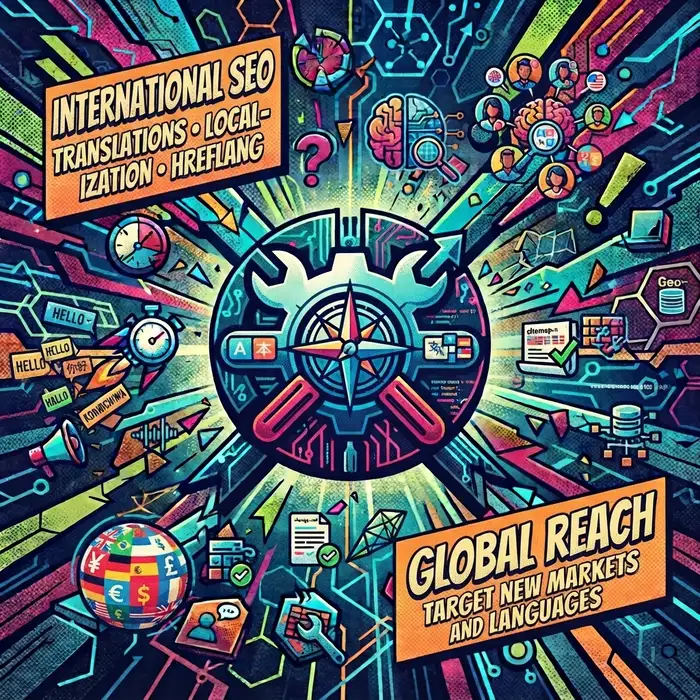
What Is an International SEO Consultant?
Someone who makes one business findable, correctly, across multiple countries and languages, without the versions competing or the wrong one ranking in the wrong place. It is part technical setup, part local market knowledge. We have competed and advertised in German, French and Spanish for fifteen years, since long before machine translation was usable, so the half of the work that is not translation is the half we know best.
What's the Difference Between Translation and Localisation?
Translation converts your words into another language. Localisation adapts your business to how that market actually searches and buys: the terms they type, the currency, the questions they ask, the competitors they weigh you against. A translated page is correct. A localised one is found. The gap between them is where most expansions fail.
What Is Hreflang and Why Does It Matter?
Hreflang is the code that tells search engines which version of a page belongs to which language and region. Get it right and each searcher sees the version meant for them. Get it wrong, which is common because it fails silently, and Google serves the wrong version or lets your own pages compete across borders. It is the most misconfigured thing in international SEO.
Should I Use Country Domains, Subdomains or Subfolders?
It depends on your size, your markets and your existing authority. Country domains signal strongest locally but split your authority; subfolders keep it consolidated but signal less. There is no universal right answer, only the right one for your situation, and it is worth settling early, because changing it later is painful.
How Long Until a New Market Ranks?
Slower than your home market, because each new language region builds its authority from scratch. The technical setup is weeks; the rankings build over months, market by market. Launching fewer markets properly beats launching many at once and badly.
Can't I Just Use AI to Translate My Site?
You can, and it will be fluent. It will not be localised. The model translates your words, not the way the market searches, so you end up with correct text nobody in that country would ever type into Google. Translation is the easy, cheap part. Knowing how a place actually searches is the part that ranks.
How Many Markets Should I Launch at Once?
Fewer than you want to. Each market needs its own structure, its own localisation and its own time to build authority, so spreading thin across many at once usually means underperforming in all of them. One or two priority markets, done properly, almost always beat five done at all.
AI will translate your site by lunchtime. It still won't know what the locals type into Google.
Find the markets actually worth winning.
Most international SEO problems are one of two things: a market that was never worth the effort, or a good market quietly broken by a technical fault nobody spotted. A short call, and a look at where you are trying to grow and how your current setup is holding up, is usually enough to tell you which markets are worth your money and what it would take to actually win them.